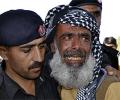
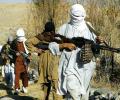
The banned Tehrik-e-Taliban Pakistan has welcomed as a "good omen" the decision of the country's political parties to hold talks with it and other militant groups.
.jpg)
Pundits in Pakistan and also some western diplomats are predicting that the next army chief will be forced, partly by institutional pressure and partly by circumstances, to indulge in some tough talking with the civilian leadership. How the civil-military equation settles in this sort of a situation is something that will determine the future of Pakistani politics, and also Pakistan's relations with rest of the world, says Sushant Sareen.

Since January, at least 190 cases of ceasefire violations by the Pakistan Army have been reported from the Line of Control in Jammu and Kashmir.
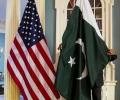
The relations between Pakistan and the US nosedived this January after US President Donald Trump accused Islamabad of giving nothing to Washington but "lies and deceit" and providing "safe haven" to terrorists.

Pakistan's political crisis deepened on Monday with cleric Tahir-ul-Qadri giving a fresh 48-hour ultimatum to Prime Minister Nawaz Sharif to step down after a former top election commission official backed protesters' allegations of rigging in last year's polls.

Gen Sharif had earlier promised to bow out at the end of his term in November this year.

Against the backdrop of Pakistan's opposition to American drone strikes, United Nations chief Ban Ki-moon on Tuesday said the pilotless aircraft should be used only for gathering intelligence.

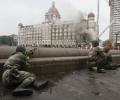
Experts trace the reasons for the 26/11 attacks to the Pakistan's military interest in three key areas: Kashmir, Afghanistan and nuclear armaments.
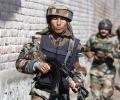
'After General Raheel Sharif took on the Tehrik-e-Taliban Pakistan, some sections of the military establishment may have felt unease as to whether the crackdown could be extended against friendlier 'non-State' actors like the Lashkar-e-Tayiba.'
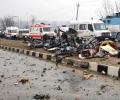
'A resurgent Jaish could be a reflection of the Pakistani security establishment's view that with the region moving ever closer to a post-US Afghanistan, it is time to redirect attention to Kashmir.'
Pakistan National Security Advisor Sartaj Aziz brings to New Delhi a newfound Pakistani confidence, stemming from its leverage in Afghanistan, says Ajai Shukla
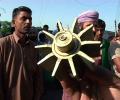
New Delhi's decision not to call for a flag meeting underlines its conviction that the military cost will soon become too high for Pakistan.

'A close look at the time-lines tells you that exactly as the back-channel negotiations were in their most crucial stage, "somebody" was planning the 26/11 attacks in Mumbai,' says Shekhar Gupta questioning Khurshid Mahmud Kasuri's account of a peace deal with India.

Protesting against enforced disappearances in Balochistan, Abdul Qadeer Baloch, 72, has led a small group that has covered more than 2,000 kilometres on foot, breaking the 84-year-old record set by Mahatma Gandhi during his Dandi march. Hamid Mir reports from Islamabad.
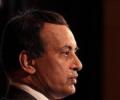
It has been over two years since Husain Haqqani was forced to resign from the coveted post of Pakistan's envoy to the United States.

After Modi became the prime minister, the Indo-US relationship has seen an upward trajectory, he said.

The United States drone attack that killed Pakistani Taliban chief Hakimullah Mehsud has done "serious damage" to the Islamabad's efforts for a dialogue with militants, Prime Minister Nawaz Sharif said on Tuesday.
Through its early days to the 1980s, Pakistan sought to expand its sphere of Islamic influence through Afghanistan to Central Asia and got Pakistani citizens recruited in the Afghan government institutions in the 1990s when the Taliban were power. Now, it is looking eastward through India to Bangladesh and Myanmar to establish an imaginary caliphate.

The US needs to do three things to help the newly elected Nawaz Sharif government in Pakistan, says Stanley A Weiss
